





Executive Summary
Dylan Field and Evan Wallace met as computer science students at Brown University. Field left to take a $100,000 Thiel Fellowship, and the two founded Figma in 2012 around Wallace's WebGL rendering work, which made vector design possible inside a browser. Adobe agreed to buy Figma for $20B in September 2022; after UK and EU competition regulators objected, the two companies dropped the deal in December 2023 and Adobe paid a $1B termination fee. Figma listed on the NYSE on July 31, 2025 at $33 a share and closed its first trading day at $115.50.
- Year-over-year revenue growth has risen for three straight quarters: 38% in Q3 2025 ($274.2M), 40% in Q4 2025 ($303.8M), 46% in Q1 2026 ($333.4M) and 48% in Q2 2026 ($370.1M).
- At June 30, 2026 Figma had 15,964 paid customers above $10,000 of ARR (+34%) and 1,635 above $100,000 (+46%), with net dollar retention of 136%.
- More than 80% of paid customers above $10,000 of ARR were using AI credits every week at June 30, 2026, and over half were using the Figma agent weekly by July 31.
"Q2 was Figma's third straight quarter of accelerated revenue growth." - Dylan Field, Co-Founder and CEO of Figma, Q2 2026 earnings release.
Company & Product
Figma runs in the browser on WebGL and WebAssembly, so files live in the cloud and several people can edit the same file at once. The product line grew from Figma Design to FigJam (2021), Dev Mode (2023) and Figma Slides (2024), then to Figma Make, Sites, Buzz and Draw in 2025. Figma bought the open-source CMS Payload in June 2025 and AI image and video startup Weavy, now Figma Weave, in October 2025. At Config 2026 it added Code Layers, Motion, Shaders, 3D Transforms and the Figma agent. Figma sells seats by plan (Starter, Professional, Organization and Enterprise) and by seat type. It started enforcing AI credit limits on all seats on March 18, 2026, and Q2 2026 was the first full quarter in which AI credits were sold as add-ons. Q2 2026 gross margin was 84% on a GAAP basis and 85% non-GAAP.
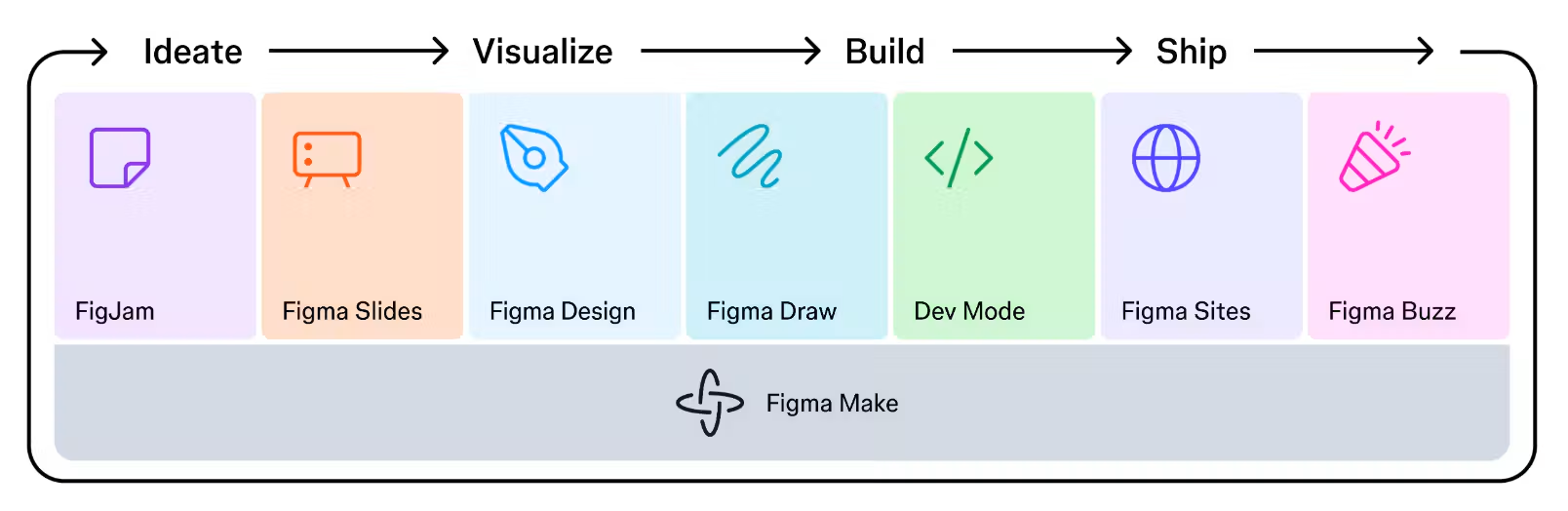
- Figma Design, FigJam & Dev Mode: The core canvas, whiteboard and developer handoff tools, used by 95% of the Fortune 500 according to the IPO prospectus.
- Figma Make & Code Layers: Code Layers turns static designs into code-backed prototypes that can be edited in code or on the canvas, and Make can now work inside a team's production codebase. About 60% of customers above $100,000 of ARR used Make weekly in Q1 2026.
- Figma agent, Motion & Weave: A built-in agent that automates repetitive work and generates animations and shaders, with Skills that let teams teach it their own processes; Weave Tools turn AI image and video workflows into reusable tools on the canvas.
Market Opportunity
Figma displaced Sketch and pushed Adobe XD into maintenance mode, and it is now selling into engineering, motion design, web publishing and marketing work. Because two-thirds of its monthly users are product managers, engineers and marketers, seat growth tracks the size of whole product organisations. Competition is coming from AI tools that generate interfaces and code from prompts (Lovable, Vercel's v0, Bolt and Cursor), from Anthropic, which released design tools in April 2026, from visual-communication platforms such as Canva and Miro, and from creative suites including Adobe, Framer and Webflow.
- Large accounts: Figma had 67 customers paying more than $1M of ARR at the end of 2025.
- Retention: Net dollar retention peaked at 139% in Q1 2026, its highest in more than two years, and was 136% in Q2.
Performance & Funding
Figma raised about $749M privately across seven rounds. Index Ventures led the 2013 seed, Greylock the December 2015 Series A, Kleiner Perkins the February 2018 Series B and Sequoia the February 2019 Series C; a16z led the April 2020 Series D at a $2B valuation and Durable Capital the $200M Series E in June 2021 at $10B. A 2024 employee tender valued Figma at $12.5B after the Adobe deal fell through. Before the IPO, Index held about 13% and Greylock about 12%. Figma and selling shareholders sold about 36.9M shares at $33 in the July 2025 IPO, raising about $1.2B at a valuation of roughly $19.3B. The shares hit $142.92 on the first day and closed at $115.50, then fell as low as $16.60; they traded at about $23 on October 26, 2026, a market capitalization of about $13.1B.
Growth & Traction
Figma passed $1B of annual revenue in FY2025 ($1.056B, +41%), with non-GAAP operating income of $129.5M (12% margin) and adjusted free cash flow of $242.7M (23% margin). The GAAP net loss for the year was $1.3B, mostly because of a one-time $975.7M stock-compensation charge recognized at the IPO. Revenue for the first half of 2026 was $703.5M (+47%), and Figma held $1.7B of cash, cash equivalents and marketable securities at June 30, 2026.
- Acquisitions: Payload (June 2025) and Weavy (October 2025), whose price was not disclosed; Israeli press estimated it at $150M to over $200M.
- Guidance raises: Full-year 2026 revenue guidance went from $1.366B to $1.374B in February to $1.422B to $1.428B in May (+$55M) and $1.463B to $1.467B in August (+$40M). Non-GAAP operating income guidance was raised to $125M to $135M in May and held in August.
Investment Outlook
Revenue growth has picked up while the share price has fallen from $115.50 on the first day to about $23 in late October 2026, roughly 9x the midpoint of 2026 revenue guidance. Stock compensation keeps GAAP results negative: Q2 2026 showed a GAAP operating loss of $117.3M against non-GAAP operating income of $36.1M, and AI inference costs were the biggest reason free cash flow fell from a year earlier. Investors are weighing how far AI coding and design agents cut into demand for design seats. Anthropic's Mike Krieger left Figma's board on April 14, 2026, the day reports surfaced that Anthropic's next model would ship design tools. Weekly AI-credit use by more than 80% of larger customers, and Make and agent adoption at enterprise accounts, are the numbers to watch in the Q3 2026 report due November 4.

 4,231+ have already joined