




Executive Summary
Stoke Space’s founding thesis is a bet on physics and unit economics over engineering caution. The company’s founders left Blue Origin not because they thought full rocket reusability was impossible, but because they believed no one was pursuing it seriously enough. Their design approach is built around a critical insight: the reason SpaceX has not achieved a 24-hour turnaround despite promising it in 2017 is not the first stage, which it already reflights in days, but the second stage, which must be replaced after every mission. Stoke Space’s metallic cooled heat shield, unlike SpaceX’s ceramic tiles or the ablative coatings used by other vehicles, can be reused without replacement, inspection time, or refurbishment that extends turnaround beyond 24 hours. The company’s execution timeline has been methodical: NSF grant in May 2020, seed round in February 2021, Hopper2 second-stage vertical landing test in September 2023, first-stage engine hotfire in June 2024, LC-14 groundbreaking in October 2024, Series C in January 2025, NSSL Lane 1 selection in March 2025, $860M combined Series D in late 2025 and early 2026, and first orbital launch of Nova expected in 2026. All major technical milestones have been met. The outstanding risk is the one that every orbital launch startup faces: the gap between component-level testing and successful orbital flight.
- Founded fall 2019 by two Blue Origin propulsion PhDs; YC W2021; $1.4B raised through Series D extension (Feb 2026); 425 employees.
- Key technical milestones: Hopper2 second-stage VTVL test (Sep 2023), first full-flow staged combustion first-stage engine hotfire (Jun 2024), LC-14 construction underway (Oct 2024).
- NSSL Phase 3 Lane 1 selected (Mar 2025): eligible for up to $5.6B in US Space Force contracts; first orbital launch expected 2026.
Company & Product
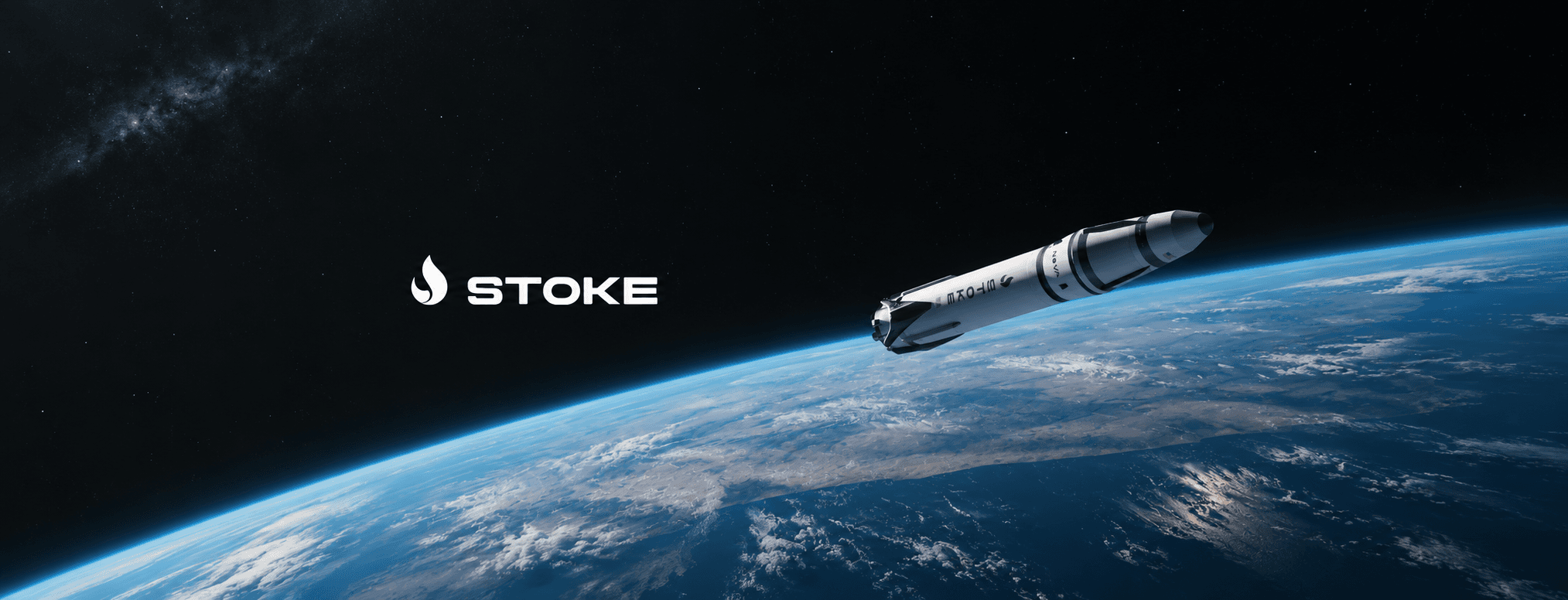
Nova is Stoke Space’s fully reusable medium-lift orbital rocket designed to carry 3,000 kilograms to LEO in its reusable configuration. The first stage uses seven Zenith full-flow staged combustion (FFSC) engines, an engine cycle that achieves maximum efficiency by routing all propellant through both the fuel and oxidizer turbopumps before combustion. Each Zenith engine produces over 100,000 pounds-force of thrust. FFSC is the same cycle used in SpaceX’s Raptor engine on Starship; Stoke Space designed and built its Zenith engine from scratch in 18 months. The rocket is built from 97% recycled stainless steel and is designed for 100 launches, compared to Falcon 9’s record of 34 and New Glenn’s design target of 25. The second stage is what distinguishes Nova from every other medium-lift rocket currently operational. Rather than ceramic heat tiles or ablative coatings, Nova’s second stage uses a cooled metallic heat shield with an integrated modular liquid hydrogen and liquid oxygen engine. This LH2/LOX propellant combination also enables Nova to reach higher-energy orbits that most medium-lift vehicles cannot access. The second stage features 24 thruster nozzles around its circumference for attitude control during landing. The Andromeda 2 upper-stage engine includes improved downmass capacity, positioning Nova for the emerging market of returning high-value manufactured goods from orbit. Alongside Nova, Stoke Space develops Boltline (formerly Fusion): a SaaS platform for hardware engineering configuration management, sold to aerospace, biotech, and advanced manufacturing teams, with revenue doubling in H1 2025.
- Nova first stage: 7 Zenith FFSC engines (100K+ lbf each); built in 18 months; 97% recycled stainless steel; designed for 100 launches vs Falcon 9’s record 34.
- Nova second stage: cooled metallic heat shield (no tile replacement needed), LH2/LOX engine (high-energy orbit access), 24 attitude-control nozzles, Andromeda 2 engine with downmass capability.
- Boltline (SaaS): hardware engineering configuration management; customers include ispace and Intuitive Machines; revenue doubled in H1 2025
Market Opportunity
Stoke Space targets two customer segments: commercial satellite operators and the US government. On the commercial side, global satellite operators have announced or filed plans for 70,000 LEO satellites to launch between 2025 and 2031, roughly six times the number of satellites that were in orbit at the end of 2024. FCC regulations require LEO satellites to deorbit within five years, creating recurring replacement demand even if constellation sizes plateau. Despite SpaceX’s 85% share of US orbital launches in 2025, approximately 74% of those launches were for SpaceX’s own Starlink network, leaving a significant gap in availability for commercial third-party customers. Nova’s 3,000 kg LEO capacity is specifically designed to match the typical payload of commercial customer dedicated launches. The launch services market was valued at $18.2 billion in 2025 and is projected to reach $45.9 billion by 2034 at approximately 10.8% CAGR. On the government side, the NSSL Lane 1 selection opens a $5.6 billion contract pool, while the Golden Dome missile defense architecture represents a potentially transformative demand driver. The downmass market is an additional untapped opportunity: SpaceX’s Dragon is currently the only vehicle capable of returning cargo from orbit intact, and the growing orbital manufacturing and pharmaceutical sector needs a second downmass provider.
- 70,000 LEO satellite plans filed for 2025-2031; FCC 5-year deorbit rule creates recurring replacement demand regardless of constellation growth.
- SpaceX flew 165 Falcon 9 missions in 2025, 74% for Starlink; commercial third-party customers face constrained access and scheduling delays, creating pricing power for dedicated medium-lift competitors.
- Downmass market: SpaceX Dragon is the sole orbital downmass provider; pharmaceutical companies could earn $2.8-4.2B processing drugs in orbit; Nova’s Andromeda 2 engine includes improved downmass capability.
“Commercial customers are willing to pay more than what incumbent launch providers like SpaceX charge to receive launch availability.” — Andy Lapsa, Co-Founder and CEO, Stoke Space
Performance & Funding
Stoke Space’s funding history tracks closely with its technical milestones. The NSF SBIR Phase I grant of $225,000 in May 2020 funded the first engine injector prototype built in a shipping container in Feldman’s backyard. A $9.1 million seed round in February 2021, led by MaC Venture Capital with angels including Thomas Tull and Kyle Vogt, funded the early team and facilities, followed by YC participation in Winter 2021. A $65 million Series A in December 2021 brought in Breakthrough Energy, NFX, Industrious Ventures, and 776, enabling the Hopper2 vehicle development. The $100 million Series B in October 2023, with Industrious Ventures leading, funded the Zenith engine program, the first-stage test facilities, and the LC-14 land acquisition at Cape Canaveral. The Series C of $260 million in January 2025 (at approximately $921.7 million valuation) coincided with the NSSL Lane 1 selection two months later, establishing the government contract pipeline needed to justify the full Series D. The Series D of $510 million in October 2025 (at approximately $2 billion valuation) was led by Thomas Tull’s US Innovative Technology Fund, with 776, Breakthrough Energy, Glade Brook Capital, Industrious Ventures, NFX, and Woven Capital participating. A $100 million debt facility from Silicon Valley Bank closed simultaneously. The Series D extension of $350 million in February 2026 brought the combined Series D to $860 million, the largest single fundraise in Stoke Space’s history, and total primary equity funding to $1.4 billion.
- Seed $9.1M (Feb 2021) → Series A $65M (Dec 2021) → Series B $100M (Oct 2023, ~$401M val) → Series C $260M (Jan 2025, ~$921M val) → Series D $510M (Oct 2025, $2B val) + $350M extension (Feb 2026) = $860M total Series D.
- Also raised $100M in debt (SVB, Sep 2025) alongside Series D equity; total capital, including debt: approximately $1.5B.
Growth & Traction
Stoke Space’s traction is measured in engineering milestones, not revenue, since the company has not yet launched a commercial mission. The September 2023 Hopper2 test demonstrated what no other orbital launch startup has demonstrated on a full second stage: controlled vertical takeoff and vertical landing of a reusable orbital upper stage at a test altitude of 30 feet for 15 seconds. This was not a suborbital demonstration; it was a full second-stage vehicle, with the same cooled metallic heat shield, 24 thruster nozzles, and LH2/LOX engine that will fly on Nova. In June 2024, Stoke completed the first hot-fire of its full-flow staged combustion Zenith first-stage engine, designed and built in 18 months. This is the same propulsion cycle used in SpaceX’s Raptor engine, and no other American medium-lift startup has demonstrated FFSC successfully to date. On the customer and regulatory side, the NSSL Phase 3 Lane 1 selection in March 2025 placed Stoke Space in the same government launch competition as SpaceX, Blue Origin, Rocket Lab, and ULA. The LC-14 license at Cape Canaveral was obtained in October 2024; Stoke broke ground with heavy machinery within 24 hours. The launch facility includes a Horizontal Integration Facility, launch mount, umbilical support structure, flame trench and diverter, and propellant systems, with full activation expected by early 2026. Commercial customer commitments include Celestis (a space burial company) booking Nova for a deep-space memorial flight.
- Sep 2023: Hopper2 VTVL test (second stage, 30ft, 15 seconds), the first successful fully reusable orbital upper-stage test by any commercial launch company.
- Jun 2024: First hot-fire of full-flow staged combustion Zenith first-stage engine, designed and manufactured in 18 months.
- Mar 2025: NSSL Lane 1 selection; Oct 2024: LC-14 license + immediate groundbreaking at Cape Canaveral; first launch expected in 2026.
“Stoke Space completed the design and manufacturing of this engine in just 18 months.” — Stoke Space press release, June 2024
Investment Outlook
Stoke Space is a pre-revenue, pre-launch deep tech bet: $2 billion in valuation on a company that has not yet reached orbit. The rationale for that valuation is a combination of technical de-risking (Hopper2 test + FFSC hotfire + LC-14 construction) and market timing (70,000 satellite plans, government demand through NSSL, downmass as an untapped market). The bull case is structural: if full reusability at 24-hour turnaround cadence is achievable, Stoke Space would be the only medium-lift provider offering airline-economics for spaceflight, capturing share from both SpaceX (too capacity-constrained and Starlink-focused) and Rocket Lab (smaller payload class). The NSSL Lane 1 position provides a government revenue floor once launches begin. The bear case is both specific and historical. Of 142 small launch startups active in 2006, only SpaceX and Rocket Lab have achieved repeatable orbital launch as of June 2026. Full second-stage reusability remains unproven in orbital flight conditions; the Hopper2 test was 30 feet, not orbital velocity. SpaceX’s Starship is designed to eventually offer full reusability at heavy-lift scale with potentially sub-$150/kg costs, which would pressure medium-lift economics even if Stoke Space launches successfully. Blue Origin’s launchpad explosion in May 2026 (which could delay its missions until 2028 per NASA) is a reminder of how unpredictable the launch environment remains. Stoke Space’s 425-person team must execute the most technically demanding milestone still ahead of it, an orbital launch, without any of the safety net that established programs have from prior flight data.
- Key upside: First and only orbital launch startup pursuing full second-stage reusability; 24-hour turnaround target would be 10x faster than any current launch provider; $5.6B NSSL government contract pool available once Nova demonstrates orbital capability.
- Key upside: Downmass market (SpaceX Dragon currently sole provider) and high-energy orbit access via LH2/LOX propulsion are differentiated capabilities that peers cannot match without full platform redesign.
- Key risk: Full reusability in orbital flight conditions remains completely unproven; of 142 launch startups in 2006, only SpaceX and Rocket Lab have achieved repeatable orbital launches; Starship full reusability would compress medium-lift economics at scale.

 4,231+ have already joined