



Executive Summary
Chris Power founded Hadrian in November 2020 after spending months with U.S. aerospace machine shops and concluding that retiring machinists and manual processes were limiting defense and space production. Hadrian built its Opus software to program and run CNC machines with far fewer people. In 2025 and 2026 it added Hadrian Maritime, Hadrian Additive and Factories-as-a-Service, opened Factory 3 in Mesa, Arizona in January 2026 and Factory 4 in Cherokee, Alabama in March 2026, and won an Army contract to build a facility at Red River Army Depot. Its $1.37B Series D on August 6, 2026 valued it at $7.87B, nearly five times its $1.6B valuation in January.
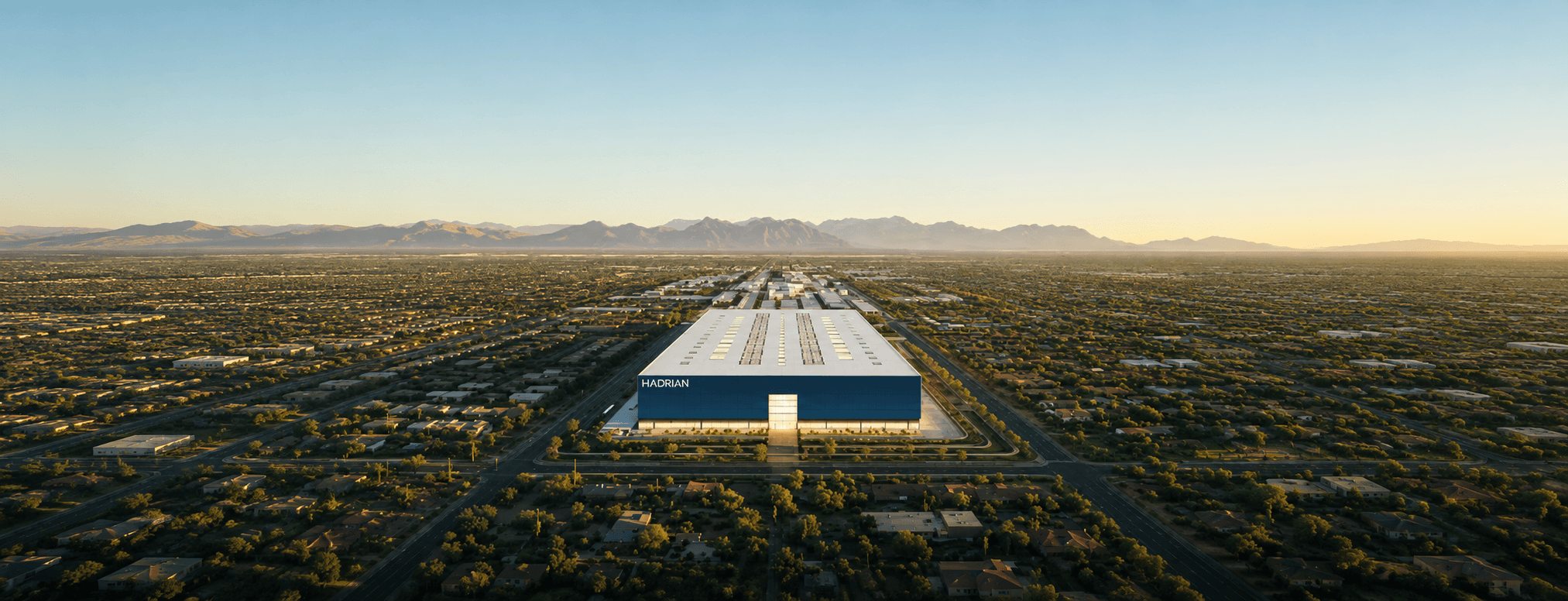
- Hadrian runs about 2.85M sq ft across four facilities: two in Torrance, the 290,000 sq ft Factory 3 in Mesa ($200M investment) and the 2.2M sq ft Factory 4 in Cherokee, a $2.4B public-private project for Virginia- and Columbia-class submarine parts.
- In 2024 Power said automated programming already let one person run four to six machines at once in Torrance.
- On October 14, 2026 Hadrian signed a seven-year agreement with Lockheed Martin to place automated cells, operated by Lockheed's own workforce, inside its Grand Prairie, Texas plant for PAC-3 MSE, THAAD, PrSM and GMLRS parts. The first 24-machine cell is due to start commissioning in early 2027.
"This is a no-fail mission to make sure that we have the production capability domestically." - Chris Power, Founder and CEO of Hadrian, to Axios on the Series D
Company & Product
Hadrian combines commercial 5-axis CNC machines, robotic loading, automated inspection and its own Opus software. Opus automates quoting, toolpath and machine programming, and quality checks, and Hadrian says it can bring a new factory online in under six months. Its factories make precision components for missiles, aircraft, rockets and submarines. Hadrian makes money by manufacturing parts and assemblies in its own factories and through Factories-as-a-Service, where defense primes or military customers contract for dedicated production capacity in a Hadrian plant or inside their own facility. Lockheed Martin's Grand Prairie cell is the first large example of the second model.
- Opus & automated machining: Software that handles quoting, CNC programming, machine operation and inspection across Hadrian's plants.
- Factories-as-a-Service & full systems: Dedicated production lines for munitions, missiles and other programs, including embedded cells at Lockheed Martin.
- Hadrian Maritime & Hadrian Additive: Divisions launched in July 2025 and January 2026 for naval shipbuilding parts and qualified 3D printing for defense programs.
Market Opportunity
Contrary Research describes the defense supply base as thousands of small machine shops, roughly 90% of them with fewer than 20 employees, with no single shop holding more than 1% share. Shortages of skilled machinists and long setup times have created backlogs in munitions, submarines and space hardware, and the Navy plans two more facilities like Factory 4. Competitors include automated manufacturing startups such as Machina Labs, Divergent Technologies and Bright Machines, machining software providers such as CloudNC, manufacturing marketplaces Xometry and Protolabs, and established aerospace suppliers such as Howmet Aerospace and Precision Castparts. Hadrian differs by owning both the software and much of the production capacity.
Performance & Funding
Hadrian has raised about $2B of equity, per PitchBook. It raised a $9.5M seed in April 2021, a $90M Series A in 2022 (led by Lux and, for the A-prime tranche, a16z) and a $117M Series B announced in February 2024, led by Construct Capital and including about $25M of equipment debt. Founders Fund and Lux led a $260M Series C in July 2025 alongside a Morgan Stanley factory loan facility, and T. Rowe Price led a January 2026 round at $1.6B with Altimeter, D1, StepStone, 1789 Capital and existing investors. On August 6, 2026 Hadrian raised a $1.37B Series D at $7.87B. JPMorganChase's Strategic Investment Group anchored the round, WCM Investment Management, Washington Harbour Partners, Valor Equity Partners, 137 Ventures and Baillie Gifford co-led, and 1789 Capital, Morgan Stanley Wealth Management, Apollo-managed funds, T. Rowe Price, CapitalG, a16z, Founders Fund, Lux and Altimeter took part. A week later Morgan Stanley Senior Funding led a $360M revolving credit facility with Western Alliance, J.P. Morgan, First Citizens, Customers Bank, HSBC Ventures USA, Axos Bank and Texas Capital.
Growth & Traction
Hadrian went from a single Los Angeles-area factory to about 2.85M sq ft across four facilities by March 2026, with a fifth under construction at Red River Army Depot.
- Factory 3 and Factory 4: Opened the 290,000 sq ft, $200M Mesa factory on January 29, 2026 (350 jobs) and the 2.2M sq ft Cherokee, Alabama factory on March 20, 2026, a $2.4B project ($900M Navy, $1.5B private) expected to create up to 1,000 jobs and reach full-rate production within about two years.
- Defense contracts: An Army contract worth up to $80M to build an advanced manufacturing facility at Red River Army Depot (March 18, 2026) and the seven-year Lockheed Martin agreement (October 14, 2026), with commissioning in early 2027.
- Headcount: About 600 employees by September 2026, up from 382 in February.
Investment Outlook
With $1.73B of new equity and credit raised in August 2026, plus embedded production at Lockheed Martin and Navy-funded submarine capacity, Hadrian is positioning itself as a large independent manufacturer for U.S. defense programs. The $7.87B valuation, up nearly fivefold in seven months, rests on factories that carry heavy fixed costs, depreciation and utilization risk. Hadrian has to keep its new plants busy, pass defense qualifications such as SUBSAFE, and move from machining parts to building complete assemblies.

 4,231+ have already joined