




WealthTech
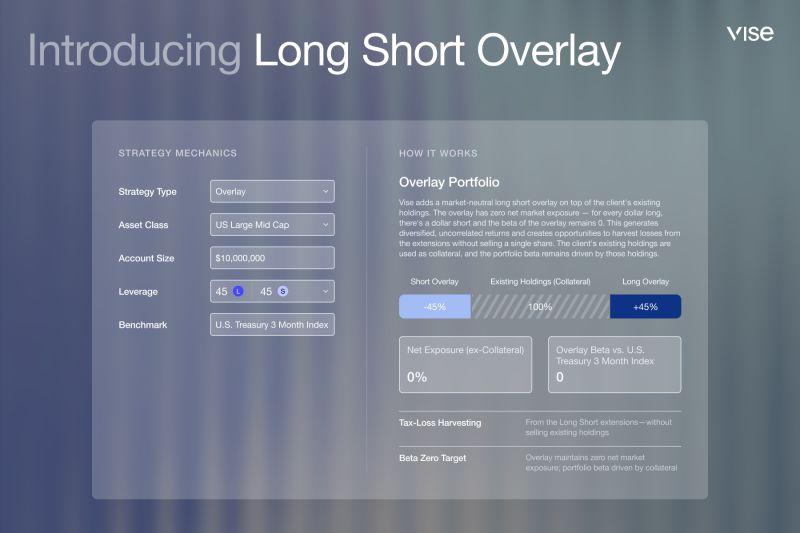
Vise is an AI-powered investment management platform that enables registered investment advisors and enterprise wealth management firms to build, manage, and explain deeply customized portfolios for each client, automating portfolio construction, tax-optimized rebalancing, and daily tax-loss harvesting through a proprietary non-linear optimizer that completes in under a second. Founded in 2016 in New York by Samir Vasavada and Runik Mehrotra, who first met at age 13 at a Northwestern University summer camp and had already built their first company together before Vasavada dropped out of high school, the platform launched commercially in late 2019, raised a $65 million Series C led by Ribbit Capital in May 2021 at a $1.05 billion valuation, then restructured following an over-hiring episode that required laying off roughly half the team in 2023, and re-emerged as a lean 43-person operation focused on its core Build, Manage, and Explain product suite. Key clients include NewEdge Wealth, a $55 billion AUM firm within NewEdge Capital Group, with Vise charging 25-30 basis points on AUM for standard strategies and up to 100 basis points for premium options overlay and long/short equity strategies.
 Samir VasavadaCo-Founder and CEO
 Runik MehrotraCo-Founder and CIO

Vise was founded in 2016 by Samir Vasavada and Runik Mehrotra, two childhood collaborators who built their first startup together at age 13 and had already secured backing from Founders Fund and Bling Capital before Mehrotra finished his freshman year at the University of Pennsylvania. The company launched commercially in late 2019, grew to unicorn status with its $65 million Series C led by Ribbit Capital in May 2021, then contracted sharply after over-hiring at the peak, cutting roughly half its workforce in 2023 and rebuilding around a leaner team and a sharpened product thesis. The restructured Vise reached $15 billion in platform assets by April 2025, doubled to $30 billion by September 2025, and partnered with NewEdge Wealth, a $55 billion AUM firm, as it positions itself as the core portfolio management infrastructure for enterprise RIAs navigating private equity-driven consolidation across the independent advisory industry.
Vise’s platform is organized around three functions: Build, which constructs customized portfolios using a proprietary non-linear optimizer that runs in under a second and supports equities, fixed income, options overlays, long/short equity, ETFs, and direct indexing in a single account; Manage, which automates daily tax-loss harvesting, rebalancing, and cascading strategy updates across all client accounts simultaneously; and Explain, which uses Vise Intelligence, a large language model-powered engine fine-tuned on investment data, to generate advisor-ready trade rationale, client reports, and portfolio performance narratives. A core technical differentiator is Vise’s portfolio transition capability: rather than liquidating existing client holdings into cash before rebuilding, the platform runs multi-period scenario analysis to transition legacy mutual funds and ETFs directly into personalized portfolios within a client-defined tax budget, making it particularly attractive to advisors onboarding clients with large embedded capital gains. Custodian integrations span Schwab, Fidelity, Raymond James, Pershing, and Interactive Brokers, with the ability to ingest holdings from PDF statements using generative AI when direct custodian access is unavailable.
“Vise is everything in the background. It does the planning and the planning integrates with the investment management. It generates the portfolios, trading, and the reports for the RIAs. We want to predict the outcome that’s most useful for the advisor, and then show them the information that’s most interesting.” — Runik Mehrotra, Co-Founder and Chief Investment Officer, Vise
The global wealth management industry is projected to reach $83 trillion in assets under management by 2027, growing by $460 billion between 2025 and 2029, within which approximately 15,500 registered investment advisors in the US represent Vise’s core addressable market. Two structural forces are compressing the independent advisory landscape in ways that favor Vise’s product directly: - The breakaway advisor trend, as advisors leave wirehouses for independent practices and need infrastructure to build personalized portfolios without large operational teams. - The RIA roll-up wave, where private equity-backed enterprise RIAs have already consolidated over $1 trillion in assets with projections suggesting $4.5 trillion more in the next decade, creating large multi-advisor platforms that need a single portfolio management system to operate at scale without sacrificing personalization. The shift toward Wealth 3.0 also drives demand for platforms like Vise, with 46% of US high-net-worth investors planning to switch or add wealth managers within 12-24 months and two-thirds of them wanting greater personalization in their investment strategy.
Vise raised $2 million in 2018 from Founders Fund and Bling Capital before launching commercially, then raised a $14.5 million Series A and a $45 million Series B, both led by Sequoia Capital, within seven months of each other in 2020, reaching $60 million total ahead of its May 2021 Series C. The Series C, $65 million led by Ribbit Capital at a $1.05 billion valuation, closed as platform AUM had grown 4x between the Series A and Series B to approximately $250 million, and within months the company began a costly over-expansion that required cutting roughly half the team in 2023. Vise has not raised a primary funding round since the Series C, subsisting on $128 million in total capital across four rounds while rebuilding its platform and enterprise client base, reaching $15 billion in platform assets in April 2025 and $30 billion in September 2025, implying an estimated annualized revenue run-rate of $75 to $90 million at 25 to 30 basis points of AUM.
Vise’s growth trajectory has been non-linear: platform AUM grew 4x between its Series A and Series B in 2020, the company became a unicorn in May 2021, then contracted significantly through 2022-2023 as the company over-hired at the peak and had to reset, cutting staff to a lean team of 43 by October 2026. The platform’s subsequent rebuild has been faster, reaching $15 billion in platform assets by April 2025 and $30 billion by September 2025, a 2x increase in five months, while adding enterprise partnerships including NewEdge Wealth, a $55 billion AUM firm, in October 2024, and Manhattan West, which left the platform and returned after Vise rebuilt its tax management capabilities. As of October 2024, the platform had over 2,500 client accounts under management, and the September 2025 Bitwise partnership opened the platform to crypto allocation within customized portfolios, expanding the addressable use case for advisors who manage clients with digital asset exposure.
“Our partnership with Bitwise ensures that crypto can be integrated seamlessly into the personalized portfolios advisors are building for clients.” — Samir Vasavada, Co-Founder and CEO, Vise
Vise’s most recent disclosed valuation of $1.05 billion dates to May 2021, before the restructuring, and the actual current valuation is likely a fraction of that given four-plus years without a primary raise, a 50% headcount reduction, and compressed wealthtech multiples across the board. The recovery thesis is real: $30 billion in platform AUM at 25-30 basis points implies a $75-90 million revenue run-rate, and the RIA consolidation wave that Vise is designed to serve, projected to grow from $1 trillion to $10 trillion in consolidated assets over the next decade, is structurally ongoing. The key uncertainty is competitive: Envestnet, acquired by Bain Capital for $4.5 billion in November 2024, is a fully institutionalized competitor with deep custodian integrations and over 100,000 advisor relationships, while Parametric manages $560 billion in assets and benefits from Morgan Stanley distribution. For Vise to reach a venture-scale outcome, it must win a disproportionate share of the enterprise RIA consolidation market before incumbents close the AI customization gap that currently differentiates its product.
 4,231+ have already joined