



Executive Summary
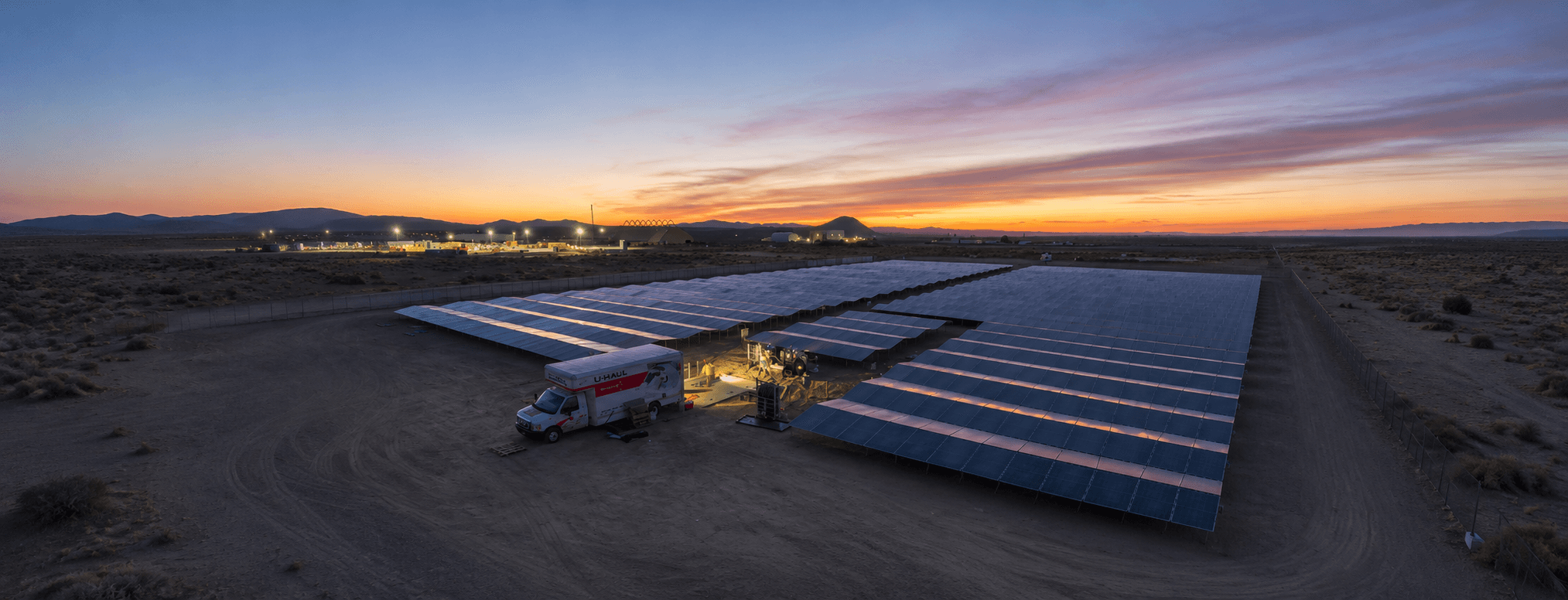
Terraform Industries is built on a single contrarian bet: that solar panels will keep getting cheap fast enough to make energy conversion efficiency irrelevant. Every other synthetic fuel company tries to solve the green premium by wringing more output from the same energy input. Terraform uses cheap, inefficient commodity components and bets that the energy they consume will eventually be close to free, deployed off-grid next to dedicated solar arrays far from city power grids. As of November 2026, the company has demonstrated the technology works at a test site in California, delivered pipeline-grade gas and methanol to utility partners, and deployed 1.8 MW of solar at its Muroc desert site. It has not yet operated at commercial scale, the original Q2 2024 production timeline has slipped by over two years, and the One Big Beautiful Bill Act (July 2025) terminated the 45V clean hydrogen credit that underpinned 84% of its projected unit revenue. The company remains in a pre-commercial, 28-person stage at a $150 million valuation on $37.7 million in total funding.
- Founded in November 2021 by sole founder Casey Handmer, a former NASA JPL engineer, inspired by Mars base fuel production technology.
- First end-to-end synthetic natural gas production demonstrated in April 2024; gas delivered to SoCalGas and PG&E at a $35/Mcf green premium.
- $37.7M seed closed in April 2026 at a $150M valuation; still pre-commercial scale as of November 2026.
Company & Product
The Terraformer is a three-module system designed to fit a 100x8-foot footprint and pair with a 1 MW solar array. The first module is an alkaline electrolyzer that splits water into hydrogen and oxygen using solar electricity, running at 50% electrical efficiency (80 kWh/kg hydrogen), deliberately less efficient than alternatives like solid oxide electrolyzers, but far cheaper to build. The second module is a direct air capture system using calcium looping: limestone absorbs atmospheric CO2, is heated to release a concentrated gas stream, and regenerates for reuse. The third is a Sabatier reactor that combines the hydrogen and CO2 to produce methane at 99.4% purity (fourth-generation reactor, April 2024), ready for injection into natural gas pipelines. All three subsystems are built entirely in-house, vertically integrated from day one. Each unit is designed to produce roughly 2 million cubic feet of synthetic natural gas per year, priced at a base of $100K per Terraformer. The energy philosophy matters: by running at 50% electrolyzer efficiency rather than 80%, the system consumes more energy per unit output, but if the electricity is generated for near-zero cost from dedicated solar, that tradeoff is favorable compared to spending more capital on an efficient electrolyzer. In December 2025, the company qualified an electrolyzer stack below $100/kW, against a long-term target of $20/kW; by May 2026, it had taken delivery of a 480-ton plastic injection molding machine for mass production of electrolyzer slices and had molded nearly 6,000 of them.
- Three in-house subsystems: alkaline electrolyzer (50% efficiency, $100/kW qualified Dec 2025), calcium-looping DAC unit, and Sabatier reactor (99.4% methane purity).
- Designed for 1 MW solar pairing, 25% utilization, producing ~2M cubic feet/year of pipeline-grade methane per unit.
- Methanol Terraformer (replaces Sabatier reactor with methanol synthesizer) is the next product line; industrial-grade methanol already produced as of May 2026.
Market Opportunity
The global natural gas market was valued at $1.3 trillion in 2025, with the US Henry Hub benchmark averaging $3.50/MMBtu in 2025. That is the market Terraform is trying to enter, not the niche synthetic methane market (projected at $225 million by 2030), but the commodity natural gas market itself, by producing synthetic gas below the market price of fossil gas. The EIA projects Henry Hub to rise from $2.20/MMBtu in 2024 to $4.80/MMBtu by 2050, driven by growing LNG exports, which widens the competitive window for synthetic alternatives. Terraform’s thesis requires either that US gas prices rise significantly, that solar costs keep falling, or both. The market opportunity expands substantially beyond methane. Terraform’s October 2024 master plan describes methane as the starting point, with green hydrogen ($282.6B market in 2025, priced at $5-11/kg vs. Terraform’s demonstrated <$2.50/kg production cost), methanol ($12.3B green methanol market by 2032), ammonia ($82.9B, 4.3% CAGR), and aluminum ($178.5B, 5.9% CAGR) as follow-on product lines. The unifying thesis is that all of these markets involve energy-intensive production processes that cheap solar power can eventually disrupt, making Terraform’s real addressable market the “primary energy consumption layer” of industrial civilization.
- Global natural gas market: $1.3T (2025); US Henry Hub average $3.50/MMBtu in 2025, projected to rise to $4.80/MMBtu by 2050.
- Terraform demonstrated green hydrogen below $2.50/kg in April 2024; market price was $5-11/kg, implying a potential 50-75% cost advantage at current scale.
- Long-term addressable markets if the energy-displacement thesis holds: ammonia ($82.9B), aluminum ($178.5B), cement ($428.5B), steel ($1.5T).
Performance & Funding
Terraform raised its seed funding in multiple tranches over approximately five years, closing the full round at $37.7 million in April 2026 at a $150 million post-money valuation. Early investors Patrick and John Collison and Nat Friedman participated in a May 2023 tranche; the closing tranche in April 2026 was led by Climate Capital, with Trajectory Ventures and Mana Ventures also participating. Despite the small funding total, the company built its first working Terraformer, demonstrated end-to-end gas production, qualified key subsystems below cost targets, and deployed solar infrastructure at a commercial test site, a capital efficiency unusual in the hard tech sector. Revenue is not publicly disclosed. The company’s June 2023 unit economics model projected up to $150K in annual revenue per deployed Terraformer: $10/Mcf from gas sales plus $54/Mcf from IRA tax credits including 45V (clean hydrogen), 45Q (carbon capture), and 45E (clean electricity), with tax credits making up 84% of projected unit revenue. The One Big Beautiful Bill Act (July 2025) terminated the 45V clean hydrogen credit for facilities beginning construction after December 31, 2027, removing a major component of that model for future units. Handmer argued that this would help Terraform relative to competitors more dependent on 45V, but the June 2023 model’s economics no longer hold as projected.
Growth & Traction
Terraform’s traction is measured in engineering milestones rather than revenue or customer metrics, appropriate for a company still building toward commercial scale. The progression from 2022 to 2026 is a consistent, if slower-than-planned, march through the technology stack: first offtake agreement (SoCalGas, September 2022), first full end-to-end gas production demo (March 2024), first gas delivery to utilities (April 2024), first methanol production (May 2026), and first hydrogen and CO2 production on pure solar at the Muroc field site (August 2026). Each milestone validates a subsystem the company built from scratch. The key manufacturing milestone is the injection molding machine delivered in May 2026, which signals the transition from prototype fabrication to serial production. By December 2025, the company had molded nearly 6,000 electrolyzer slices, qualified a stack below $100/kW (against a long-term target of $20/kW), and installed full DAC system components. The Kern County field site at Rosamond, California represents the company’s first externally sited deployment. The original Mark One production timeline was Q2 2024; as of September 2026, the company was still in test-site operations, representing a slip of roughly two-plus years.
“It shows that we have produced gas. That’s the critical thing to do.” — Casey Handmer, Founder and CEO, Terraform Industries
Investment Outlook
Terraform is a thesis-stage investment: the technology has been demonstrated at small scale, the company operates on 28 people with $37.7M total funding, and the path to commercial viability runs through continued solar cost declines, a rise in US natural gas prices, or both. The $150M valuation is modest for a climate tech hardware company at this stage, reflecting both the genuine technical progress and the significant risks: the 45V credit termination has changed the unit economics, US gas prices have stayed well below Terraform’s $10/Mcf model assumption ($3.50/MMBtu average in 2025), and the company’s first commercial deployment at Kern County is still unproven. The bull case is a long-duration bet on physics and manufacturing learning rates: solar costs have fallen 90% in a decade and are projected to fall another 30% by 2036; natural gas prices are projected to double by 2050; and the Terraformer’s design has an inherent cost floor that decreases as manufacturing scales. If those curves cross before Terraform runs out of capital, it has a viable business in a $1.3 trillion market. The bear case is that the curves don’t cross on Terraform’s timeline, that hydrogen credits don’t come back, and that the company needs to raise significantly more capital at a potentially challenging valuation to get to commercial production.
- Key upside: Solar costs projected to fall 30% more by 2036; US natural gas prices projected to rise toward $4.80/MMBtu by 2050.
- Key upside: Demonstrated green hydrogen below $2.50/kg versus $5-11/kg market price suggests meaningful cost lead in the most capital-intensive subsystem.
- Key risk: 45V clean hydrogen credit terminated for post-2027 construction starts; original unit economics assumed 84% of revenue from tax credits; commercial deployment timeline has already slipped two-plus years.

 4,231+ have already joined