



Executive Summary
Strava’s founding story is about timing. The virtual locker room idea was sound in 1995 but required GPS, smartphones, and social network infrastructure that did not yet exist. By 2009, all three had arrived. The first MVP was just a leaderboard tracking a few athletes across a handful of cycling segments in Vermont and California; athletes were calling in sick from work to ride their bikes and challenge each other on the leaderboard. By November 2025, 180 million registered users had logged more than 8 billion activities across the platform, uploading 40 million new activities per week. The core business is a freemium subscription at $79.99 per year for the individual plan, supplemented by data licensing via Strava Metro (3,700+ government and urban planning partners) and branded challenge sponsorships ($30K-$200K per sponsor). The company is approaching $500 million in ARR per its CEO’s May 2025 statement, is valued at $2.2 billion after a Sequoia-led round, and has confidentially filed for a US IPO in January 2026 with Goldman Sachs and JPMorgan as advisors. Two acquisitions in April and May 2025 (Runna for running coaching and The Breakaway for cycling coaching) marked Strava’s first major push into AI-powered personalized training plans.
- Founded in 2009; MVP: cycling segment leaderboard; 8B total logged activities, 40M per week; 180M+ registered users globally (Nov 2025), up 327% from 55M in 2020.
- Revenue model: individual subscription $79.99/year + family $139.99/year (4 users) + student $39.99/year + Strava Metro data licensing + branded challenges ($30K-$200K each).
- May 2025: $2.2B valuation (Sequoia-led, undisclosed equity+debt); January 2026: confidential S-1 filed; Barry McCarthy (ex-Peloton CEO) added to board for IPO readiness.
- “Community is our core. People say they don’t download Strava, they join Strava.” — James Quarles, former CEO of Strava (2017-2019)
Company & Product
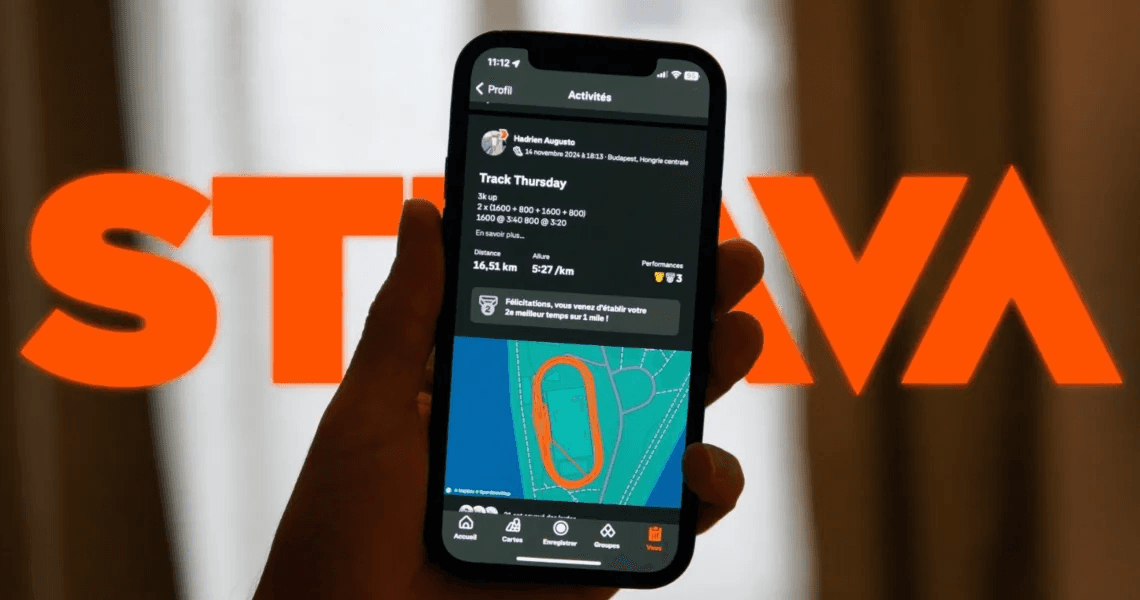
Strava’s product is built around four core pillars. First, activity tracking: GPS recording for 50+ sport categories with detailed maps, pace, elevation, and calorie data, now enhanced with a revamped “Record” interface (2025) showing a live map and stats on one screen and real-time ski/snowboard run tracking with chairlift-excluded stats for winter sports. Second, route planning: AI-powered route generation using the Global Heatmap (8 billion logged activities), tappable points of interest (cafes, restrooms, scenic overlooks), point-to-point routing, and an enhanced web Route Builder with elevation sliders and multi-sport route switching. Third, social features: a kudos-based social feed, clubs, messaging, challenges, and a November 2025 GoFundMe integration that lets athletes tag workouts for charitable fundraisers. The fourth and newest pillar is Athlete Intelligence and personalized coaching, which Strava is building aggressively through both AI development and acquisitions. Athlete Intelligence (launched October 2024 in beta) uses machine learning to transform an athlete’s full training history into performance trend summaries and goal recommendations. The April 2025 acquisition of Runna (UK running coaching app, implied valuation ~$190M based on a reported 30x early investor return) and the May 2025 acquisition of The Breakaway (AI cycling coaching, Y Combinator) added dedicated training plan engines for Strava’s two largest sports. A combined Strava and Runna subscription bundle launched in July 2025, and Power Skills and Training Zones (powered by Breakaway’s technology) launched for cyclists.
- 50+ tracked sport categories; 8B+ total logged activities; Global Heatmap AI-powered route generation; revamped Record interface (2025) with live stats overlay; real-time ski/snowboard run tracking with chairlift exclusion.
- Athlete Intelligence (Oct 2024): ML-powered training summaries; Runna acquisition (Apr 2025): running coaching bundled subscription; Breakaway (May 2025): Power Skills and Training Zones for cyclists.
- Integrations: Apple Watch, Garmin, Oura, Nike Run Club, Meta/Oakley Vanguard AR glasses, Fitbit, and 400+ third-party apps; Strava Metro: anonymized route data licensed to 3,700+ city and planning agencies.
“The magic of Strava is in that connection and belonging that people feel, and so messaging is really the next iteration of what that feels like.” — Zipporah Allen, Chief Business Officer, Strava
Market Opportunity
Strava operates in the global fitness app market, valued at $8.5 billion in 2024 and projected to reach $28.7 billion by 2029 at a 27.5% CAGR, within the larger global sports technology market valued at $22.5 billion in November 2025 and projected to reach $65.9 billion by 2034. The more specific addressable opportunity is the 700 million people globally who “wake up every day wanting to be active,” per Michael Horvath’s 2021 estimate. At $80/year per subscriber, the theoretical subscriber TAM is a $56 billion annual revenue opportunity, significantly larger than what Strava currently captures with its subscription base. Two structural tailwinds are compounding the opportunity. The first is running’s cultural resurgence: approximately 50 million Americans participated in running in 2024 (up from 11.3% of the US population in 2010 to 15% in 2024), nearly 1.1 million people applied for the 2026 London Marathon lottery in September 2025, and the UK added 349,000 new runners in 2024, driven almost entirely by Gen Z women. The second is fitness as social infrastructure: Strava’s 2024 Year in Sport report found that “making social connections” was the number one motivator for users to stay active, global running club participation jumped 59% in 2024, and 1 in 5 Gen Z users went on a date with someone they met through exercise. As Gen Z shifts its social life away from bars and toward wellness, fitness apps that enable real-world community become the new social infrastructure.
- Global fitness app market: $8.5B (2024), projected $28.7B by 2029 at 27.5% CAGR; sports technology market $22.5B (2025), projected $65.9B by 2034.
- Running boom: 50M US runners in 2024 (up from 11.3% to 15% of US population since 2010); 1.1M applied for 2026 London Marathon; 349K new UK runners in 2024, mostly Gen Z women.
- Social shift: “making social connections” overtook health and performance as the #1 motivator for Strava users (2024 Year in Sport); running club participation up 59% in 2024.
Performance & Funding
Strava’s confirmed primary equity funding history spans from inception through the November 2020 Series F. The company raised a Series D of $18.5 million around 2014, led by Sequoia Capital, with Jackson Square Ventures and Madrone Capital Partners participating. The Series F in November 2020 raised $110 million at an approximately $1.5 billion valuation, led by TCV and Sequoia Capital, with Dragoneer, Jackson Square Ventures, Madrone Capital, and Go4it Capital participating. Strava also acquired Recover Athletics (2022) and FATMAP (2023) during the intervening period. Total confirmed primary equity funding through Series F is $151.9 million, with earlier Series A through Series E rounds making up approximately $41.9 million combined. In May 2025, Sequoia Capital led an undisclosed funding round (combining equity and debt) that valued Strava at $2.2 billion, up from the $1.5 billion Series F valuation in 2020. TCV, Jackson Square Ventures, and Go4it Capital participated. The raise coincided with the simultaneous announcements of the Runna and Breakaway acquisitions. The May 2025 round brought the total to approximately $228.5 million or more. In January 2026, Strava confidentially filed a draft S-1 for a US IPO, with Goldman Sachs and JPMorgan as advisors and Barry McCarthy (former Peloton CEO, former Netflix/Spotify CFO) added to the board. This would be Strava’s first liquidity event since the company’s 2009 founding.
Growth & Traction
Strava’s user growth accelerated dramatically during the pandemic: from 55 million registered users at the end of 2020 to 100 million by 2023 and 180 million by November 2025, a 327% increase in five years. Weekly activity uploads grew from 21.5 million in 2020 to 40 million in 2023, an 86% increase in engagement per existing user, not just user count. As of January 2026, the platform had over 8 billion total logged activities and 3.7K+ Strava Metro partner organizations. Approximately 14 billion kudos were given in 2025 alone, up 20% from 2024. The revenue picture is coming into focus even though Strava has not disclosed exact figures. CEO Michael Martin told the media in May 2025 that the company was “on track to hit $500 million in annual recurring revenue soon.” A 50% revenue growth rate was also confirmed in the same period (by Front Office Sports). At $80/year per individual subscriber, $500M ARR implies roughly 6.25 million subscribers out of 180 million total users, a conversion rate of approximately 3.5%, consistent with freemium benchmarks. Strava Metro (3,700+ partners) and branded challenges ($30K-$200K per sponsorship) contribute additional revenue on top of subscriptions. Gen Z’s outsized engagement is a core growth driver: a 59% jump in running club participation in 2024, 77% of Gen Z users reporting greater motivation to exercise after seeing friends’ Strava activity, and Gen Z being four times more likely to prefer meeting people at a workout than at a bar.
- User growth: 55M (end 2020) to 100M (2023) to 180M (Nov 2025), a 327% increase in 5 years; 40M activities uploaded per week (2023), up 86% from 2020.
- Approaching $500M ARR (CEO Michael Martin, May 2025); 50% revenue growth rate confirmed; implied ~6.25M paid subscribers at $80/year (estimated ~3.5% conversion rate).
- 14 billion kudos given in 2025 (up 20% from 2024); 59% jump in running club participation (2024); 1 in 5 Gen Z went on a date with someone met through exercise.
Investment Outlook
At a $2.2 billion valuation on a revenue run rate approaching $500 million, Strava trades at approximately 4-5x revenue, a modest multiple for a consumer subscription business with 327% user growth in five years, strong network effects, and a cultural moat around running and cycling that no pure-tech competitor has successfully challenged. The IPO process, formally initiated with a confidential S-1 filing in January 2026, positions Strava for a public debut potentially in 2026 at a valuation that could increase substantially if public market reception resembles that of fitness and social platform comps. The bull case is a network effects business with low marginal cost of growth: each new Strava user improves the Global Heatmap, populates more club leaderboards, and deepens the social graph that makes existing users stay. The 2024 cultural shift (social connection as the primary fitness motivator, Gen Z’s “third running boom”) is structural, not cyclical. The bear case is Garmin dependency: approximately 70% of Strava activities are estimated to come from Garmin hardware, and the October 2025 patent lawsuit that Strava filed and then quickly dropped revealed this structural fragility. Strava effectively conceded to Garmin’s attribution demands and may have damaged a 15-year partnership, while Garmin deepened competing integrations with Komoot. Any future disruption to the Garmin API relationship could materially impair Strava’s core functionality and user engagement.
- Key upside: $2.2B valuation at ~4-5x, approaching $500M ARR; network effects compound with each user; “third running boom” and Gen Z fitness-as-social-life is structural demand; IPO process underway.
- Key upside: Strava Metro (3,700+ city/government partners), branded challenge revenue ($30K-$200K/sponsor), and Runna/Breakaway coaching subscriptions diversify revenue beyond the core freemium model.
- Key risk: ~70% of Strava activities estimated to originate from Garmin hardware; October 2025 Garmin lawsuit filed and dropped damaged partnership; Garmin deepening integrations with competitor Komoot.

 4,231+ have already joined