



Executive Summary
Alberto Lacaze and Karl Murphy founded Robotic Research in Clarksburg, Maryland in 2002 and ran it for almost two decades as a self-funded Defense Department contractor. Its first outside capital was a $228M Series A in December 2021, led by SoftBank Vision Fund 2 and Enlightenment Capital. The company took the Forterra name in February 2024 under CEO Josh Araujo, and in November 2025 it raised a $238M Series C at a valuation above $1B.
- Forterra built and delivered 105 Lancer vehicles to Ukraine in under six months; they arrived in October 2025, and by August 2026 had completed more than 1,400 logistics missions and 88 casualty evacuations.
- Its contract base includes the first Defense Department production contract for ground-vehicle autonomy (ROGUE-Fires, with Oshkosh), a $114M Army prime contract for autonomous breaching, Phase II of GEARS and Sandhills 2.0.
- The October 2025 purchase of goTenna added tactical mesh radios and about 90 employees.
"Demos validate a proof of concept, combat deployments validate an operational capability..." -Scott Sanders, Chief Growth Officer of Forterra, on the Lancer deployment in Ukraine
Company & Product
Forterra fits autonomy onto vehicles that already exist instead of building its own chassis. AutoDrive combines a compute module with lidar from suppliers including Ouster and with thermal and electro-optical cameras, so a vehicle can drive off-road, in bad weather and without GPS. TerraLink lets operators supervise several vehicles and plugs into military tools such as TAK, Vektor carries data in contested electronic environments, and OASIS standardises how sensors and payloads attach. OASIS-OneLink, launched in October 2026, puts vehicles from different vendors under one operator interface. Forterra earns money as a prime contractor on Army programs, such as the $114M breaching contract and Sandhills 2.0 on Ford F-250 trucks, and as the autonomy supplier to vehicle makers including Oshkosh Defense, BAE Systems and Volvo Defense. It also has a commercial line of autonomous terminal tractors with Kalmar for ports and yards.
- AutoDrive, TerraLink & Vektor: Retrofit driving kit, multi-vehicle command software and communications layer, now paired with goTenna mesh radios.
- Defense prime integrations: Autonomy for the Marine Corps' ROGUE-Fires (NMESIS) launcher with Oshkosh and an autonomous Armored Multi-Purpose Vehicle prototype with BAE Systems.
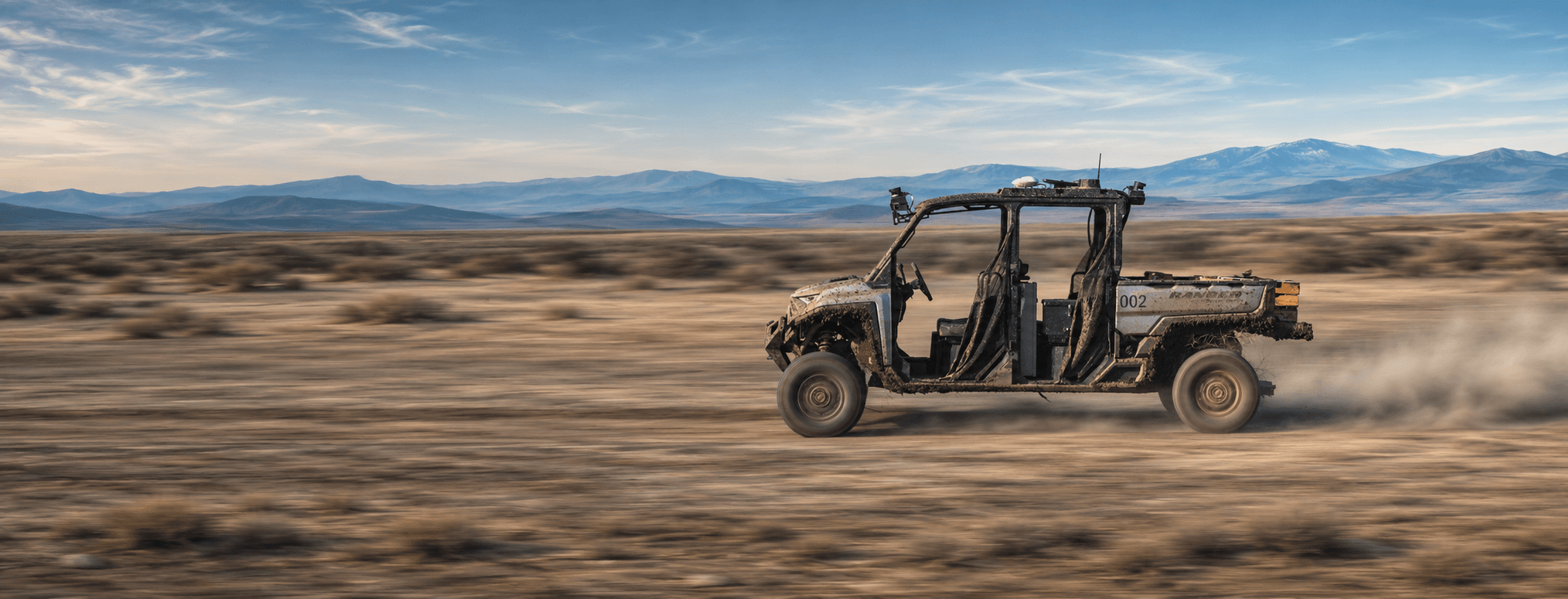
- Lancer & commercial tractors: Lancer is a Polaris Ranger 1500 fitted with AutoDrive and Vektor; the commercial line is an autonomous terminal tractor developed with Kalmar.
Market Opportunity
Contrary Research estimates that the U.S. military operates about 420,000 ground vehicles and notes that global military spending rose 9.4% to $2.7T in 2024. The war in Ukraine has made uncrewed resupply and casualty evacuation an urgent need, though Ukrainian units have so far driven Lancers mostly by remote control and have asked for cheaper vehicles because so many are lost. In commercial logistics, North American ports and distribution yards run more than 25,200 terminal tractors. Competitors include venture-backed autonomy companies such as Overland AI, Applied Intuition's defense unit, Kodiak (listed on Nasdaq as KDK in September 2025) and Scout AI, and established primes such as General Dynamics Land Systems and GM Defense that build their own autonomy.
Performance & Funding
The company took no institutional venture capital from 2002 to 2021. SoftBank Vision Fund 2 and Enlightenment Capital led the $228M Series A in December 2021, with Crescent Cove, Henry Crown and Luminar. Moore Strategic Ventures, XYZ Venture Capital and Hedosophia led the $75M Series B in September 2024. Moore Strategic Ventures also led the $238M Series C in November 2025, which included $50M of debt and valued Forterra above $1B. New investors were Salesforce Ventures, Franklin Templeton, Balyasny Asset Management, 645 Ventures, Hanwha Asset Management, 9Yards Capital, RTX Ventures and NightDragon. Adding the three rounds gives about $541M; Aviation Week reported a total of $411M.
Growth & Traction
In January 2025, Oshkosh Defense received the ROGUE-Fires production award for the Marine Corps and named Forterra as its autonomy partner, the first production contract for full-size ground-vehicle autonomy at the Defense Department. The Army's $114M prime contract, awarded in March 2025, also funded the Lancer program for Ukraine.
- Ukraine metrics: The July 7, 2026 disclosure cited more than 1,100 missions, 2,500+ miles, 777,440 pounds carried and 52 casualty evacuations. By August the count was 1,400+ missions and 88 evacuations, and a later Ouster release cited 1,426 missions over more than 7,300 miles.
- 2026 contract wins: Sandhills 2.0 in July 2026, and selection in August 2026 for the Army's Infantry Last Tactical Mile effort.
- Headcount: About 500 people after the goTenna deal in October 2025.
Investment Outlook
Forterra planned to use the Series C to expand production capacity to 1,000 units in 2026. The valuation rests on prototype and early-production programs becoming multi-year Programs of Record with steady funding lines. Ukraine shows both sides of the case. Lancers have run more than 1,400 missions under drone surveillance, but soldiers mostly teleoperate them because the software cannot yet react to unexpected enemy forces, and units want cheaper vehicles that they can afford to lose. Export controls (ITAR) on sales to European allies and the scale-up of the Kalmar yard tractor are the other items to watch.

 4,231+ have already joined